Metal sheets are widely used in various industries due to their excellent performance, but they are prone to corrosion in harsh environments, which seriously affects service life and safety. Therefore, improving their corrosion resistance is crucial. This article will analyze scientific anti-corrosion solutions from three aspects: common metal sheet materials and their corrosion resistance grades, mainstream anti-corrosion methods, and the industrial value of enhanced corrosion resistance.
I. Common Metal Sheet Materials & Their Corrosion Resistance Grades
Different metal materials have distinct inherent corrosion resistance due to variations in composition and structure. Below is a summary of common materials in industrial and civilian fields and their corresponding corrosion resistance grades (referring to international universal standards).
1. Carbon Steel / Ordinary Low-Alloy Steel
As the most basic and widely used material, its main components are iron and carbon, with a small amount of auxiliary elements. It boasts high strength, low cost, and good machinability, but extremely poor corrosion resistance, easily rusting in humid environments.
Corrosion Resistance Grade: Extremely Low (Short-term use in C1-C2 environments; mandatory anti-corrosion required for C3 and above). C1-C5 corresponds to environments from mild indoor to severe corrosion. Unprotected carbon steel will show obvious rust in C3 environments within 1-2 years.
2. Stainless Steel (Main Models: 304, 316, 316L)
Its core lies in adding alloying elements such as chromium and nickel to form a dense chromium oxide passive film that isolates corrosive media. Corrosion resistance varies among models due to different alloy contents.
Corrosion Resistance Grades:
- 304 Stainless Steel: Above Medium (Resists C1-C4, not chlorine-resistant), suitable for conventional indoor and outdoor scenarios, the first choice for civilian and general industrial use;
- 316 Stainless Steel: High (Resists C1-C5, better chlorine and acid-alkali resistance than 304), contains molybdenum, suitable for coastal, chemical and other scenarios;
- 316L Stainless Steel: Extremely High (Resists C1-C5+ severe corrosion, optimal intergranular corrosion resistance), low-carbon feature adapts to high-end fields such as severe corrosion and marine engineering.
3. Aluminum Alloy (Main Models: 1060, 3003, 5052)
It has low density and high strength, with a natural aluminum oxide passive film forming on the surface, providing basic corrosion resistance. However, the film is thin and easily damaged in complex environments.
Corrosion Resistance Grades:
- 1060 Pure Aluminum: Medium (Resists C1-C3, better than carbon steel but worse than 304), suitable for indoor decoration and light outdoor components;
- 3003 Aluminum Alloy: Medium (Slightly better corrosion resistance than 1060, better machinability), used for air conditioning ducts, food packaging, etc;
- 5052 Aluminum Alloy:Above Medium (Better corrosion resistance than ordinary aluminum, resists mild acids and alkalis), suitable for ships, auto parts.
4. Galvanized Steel (Hot-Dip Galvanized, Electro-Galvanized)
A composite material with carbon steel as the base and a zinc layer coated on the surface. The zinc layer provides sacrificial anode protection—even if damaged, it will corrode first to protect the base metal.
Corrosion Resistance Grades:
- Electro-Galvanized Steel: Medium (Zinc layer thickness 5-15μm, resists C1-C3), suitable for indoor precision parts and mild humid environments;
- Hot-Dip Galvanized Steel: High (Zinc layer thickness 45-85μm, resists C1-C4), the first choice for construction and municipal fields, with a service life of 15-25 years.
II. Common Methods to Improve Corrosion Resistance of Metal Sheets
For different materials and environments, there are various mature anti-corrosion methods in the market, mainly divided into surface modification, coating protection, and cathodic protection. Below is a detailed explanation of their principles, characteristics, and application scenarios.
1. Surface Coating Protection (Most Mainstream & Widely Used)
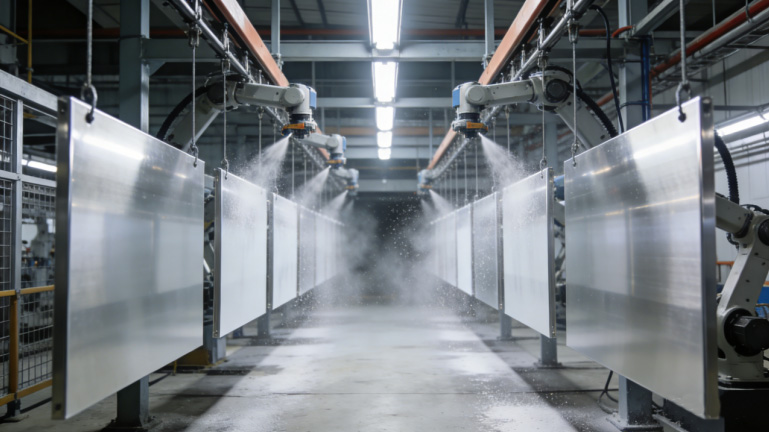
It isolates corrosive media from the base metal by applying one or more organic or inorganic coatings. With simple operation and controllable cost, it is suitable for most metal materials and environments, making it the most mainstream anti-corrosion method.
Common Types & Characteristics:
- Paint Coating: Alkyd paint is suitable for dry indoor environments; epoxy paint has strong adhesion and good acid-alkali resistance, suitable for chemical equipment and mechanical parts; polyurethane paint offers excellent weather resistance and wear resistance, achieving integrated anti-corrosion and decoration. Attention should be paid to substrate derusting (reaching Sa2.5 level or above) and matching primer and topcoat, otherwise the coating is prone to peeling, affecting anti-corrosion effect.
- Powder Coating: Powder coatings (epoxy powder, polyester powder) are adsorbed on the metal surface by electrostatic force and then cured at high temperature to form a coating. With uniform thickness (20-120μm), high hardness, and no solvent pollution, its corrosion resistance is better than ordinary paint. Suitable for aluminum and galvanized steel sheets, widely used in building curtain walls and home appliance casings.
- Fluorocarbon Coating: With fluorocarbon resin as the core, it has extremely strong weather resistance and corrosion resistance, usable in C5 environments for 20-30 years. However, the cost is high, mainly used in high-end buildings, marine engineering and other fields.
2. Surface Metallization Treatment (Sacrificial Anode / Passivation Protection)
It improves corrosion resistance by coating active metals or forming dense passive films, based on the principle of sacrificial anode or passive film isolation. Suitable for carbon steel, stainless steel, aluminum alloy and other materials.
Common Types & Characteristics:
- Hot-Dip Galvanizing / Electro-Galvanizing: Mainstream anti-corrosion methods for carbon steel sheets. Hot-dip galvanizing has strong adhesion and thick zinc layer; electro-galvanizing has high precision and smooth surface.
- Aluminizing / Chromizing: Forms alloy layers or passive films. Aluminized steel has excellent high-temperature corrosion resistance; chromizing improves the wear and corrosion resistance of stainless steel.
- Stainless Steel Passivation: Pickling and passivation enhance the density of the passive film, improving chlorine and acid-alkali resistance, which is a necessary process for stainless steel deep processing.
3. Cathodic Protection (Suitable for Severe Corrosion Environments)
It makes the metal sheet a cathode through external power supply or sacrificial anode, inhibiting anodic dissolution. Suitable for sheets long-term immersed in seawater, soil, acid-alkali solutions, such as offshore platforms and underground pipelines.
Common Types & Characteristics:
- Sacrificial Anode Type: Installs active metals such as zinc blocks, no external power supply required, simple maintenance, suitable for small equipment.
- Impressed Current Type: Forms an electric field through DC power supply, stable anti-corrosion effect, suitable for large equipment, but high initial investment and maintenance cost.
4. Material Alloying Modification (Improve Corrosion Resistance from Source)
It adjusts the composition and microstructure by adding alloying elements such as chromium and nickel, improving inherent corrosion resistance from the source, no subsequent anti-corrosion treatment required. Suitable for harsh environments with high anti-corrosion requirements.
Examples include upgrading carbon steel to stainless steel, 304 to 316, and pure aluminum to 5052 alloy. However, the cost is high, so selection should be based on actual needs to avoid over-design.
III. Benefits of Enhancing Metal Sheet Corrosion Resistance in Various Fields
Enhancing the corrosion resistance of metal sheets not only extends their service life but also reduces operating costs, ensures safety, and improves competitiveness in various fields. Below is an analysis of core values combined with specific fields.
1. Construction Field: Reduce Maintenance Costs & Extend Building Lifespan
Metal sheets are widely used in building roofs, curtain walls, etc. Insufficient corrosion resistance can easily cause leakage, rust, and other problems. After enhancing the grade, the service life can be extended from 5-10 years to 20-30 years, significantly reducing maintenance costs. For example, fluorocarbon-coated aluminum curtain walls and hot-dip galvanized steel roofs can adapt to harsh environments.
2. Automotive Field: Ensure Driving Safety & Improve Vehicle Durability
Components such as car bodies and chassis are long-term exposed to rainwater and salt spray corrosion. Insufficient corrosion resistance can easily reduce structural strength. Adopting processes such as electro-galvanizing and cathodic electrophoresis can delay corrosion, ensure driving safety, improve vehicle durability and residual value. The corrosion resistance life of high-end models can reach more than 10 years.
3. Chemical Field: Avoid Equipment Leakage & Ensure Production Safety
The chemical environment is highly corrosive. Insufficient equipment corrosion resistance can easily cause leakage, production interruption, and other safety accidents. Adopting solutions such as 316L stainless steel and fluorine-lined coatings can ensure stable equipment operation, reduce risks and economic losses, and guarantee production continuity.
4. Aerospace / Marine Engineering Fields: Break Environmental Limits & Ensure Extreme Reliability
Both fields have extreme environments with extremely high anti-corrosion requirements; corrosion may cause fatal failures. Adopting solutions such as special stainless steel and fluorocarbon coatings can break environmental limits and ensure equipment reliability. For example, the composite anti-corrosion process for ships has a service life of 15-20 years.
5. Home Appliance / Civilian Fields: Improve Product Quality & Enhance Market Competitiveness
Metal sheets are commonly used in home appliances and civilian products, and consumers value durability. Enhancing corrosion resistance can avoid rust and paint peeling, extend service life and quality, and enhance market competitiveness. For example, powder-coated refrigerator casings can adapt to humid kitchen environments.
Conclusion
Improving the corrosion resistance of metal sheets requires selecting appropriate solutions based on materials and environments, with dual protection from source and process. This not only extends the service life of sheets but also provides safety, cost, and quality guarantees for various fields, which is the key to enhancing industry competitiveness.